Comparing OpenFace and Deep Learning Models for Deception Detection in Video Calls
We introduce a new dataset of semi-controlled online meetings, where OpenFace performs well, and show that CNN-based facial Action Unit predictions outperform it on more challenging in-the-wild datasets.
Comparing OpenFace and Deep Learning Models for Deception Detection in Video Calls
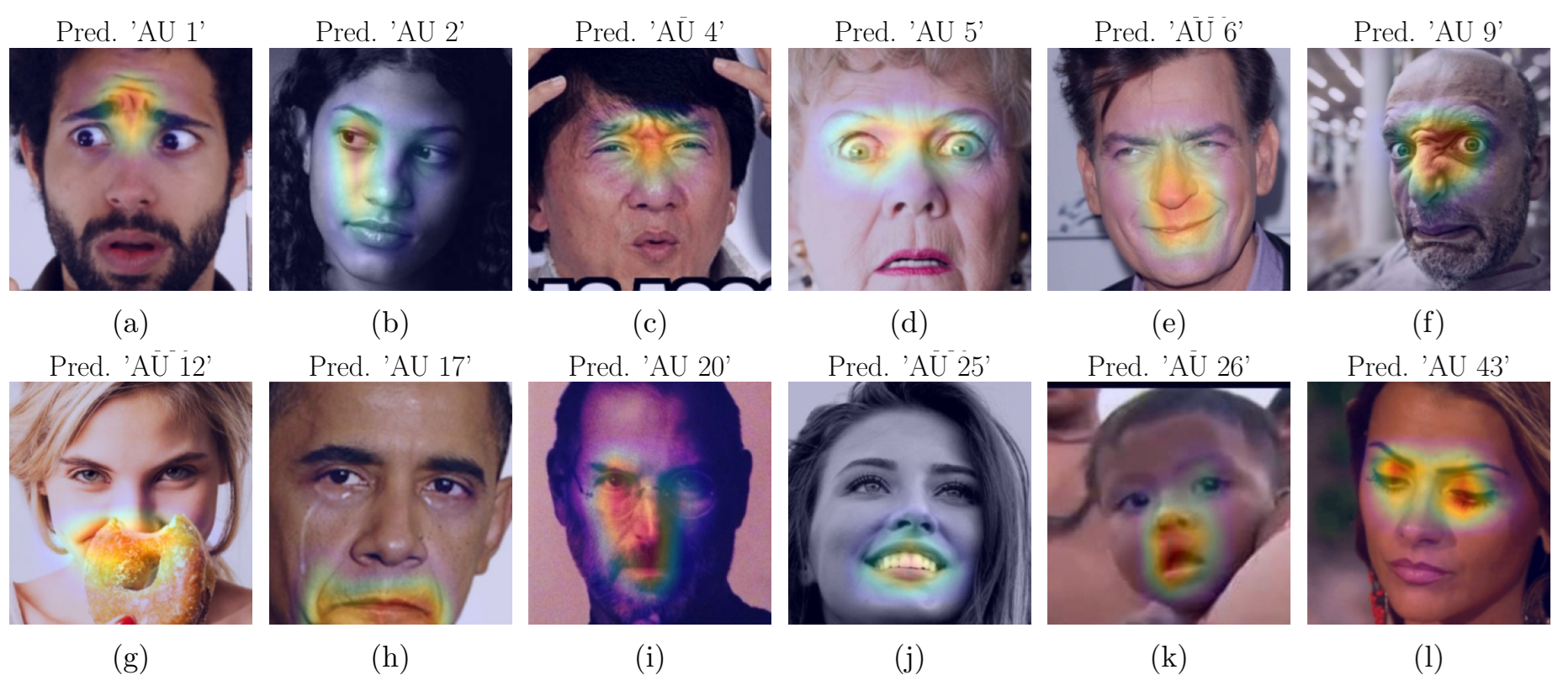
Detecting deception remotely using only audio and video is tough, especially when facial cues are subtle and vary a lot between people. In this work, we focus on facial Action Units (AUs) to model expressions in a clear and interpretable way. We introduce a new dataset collected in a controlled setting with mock online sales meetings, where participants were instructed to deceive. We also compare our dataset with the Real-life Trial dataset. Our results show that CNN-based AU prediction outperforms OpenFace on large-scale AU benchmarks and in challenging real-world deception scenarios. However, OpenFace still works best in our semi-controlled mock sales setup, where it captures additional AUs. This study highlights the strengths and limitations of different AU-based approaches for automated deception detection.
Citing
@inproceedings{dinges2025comparing,
  title={Comparing OpenFace and Deep Learning Models for Deception Detection in Video Calls},
  author={Dinges, Laslo and Fiedler, Marc-Andr{\'e} and Al-Hamadi, Ayoub and Bershadskyy, Dmitri and Weimann, Joachim},
  booktitle={2025 14th International Symposium on Image and Signal Processing and Analysis (ISPA)},
  pages={231--236},
  year={2025},
  organization={IEEE}
}