AI-based bi-modal fusion system for automated clinical pain monitoring
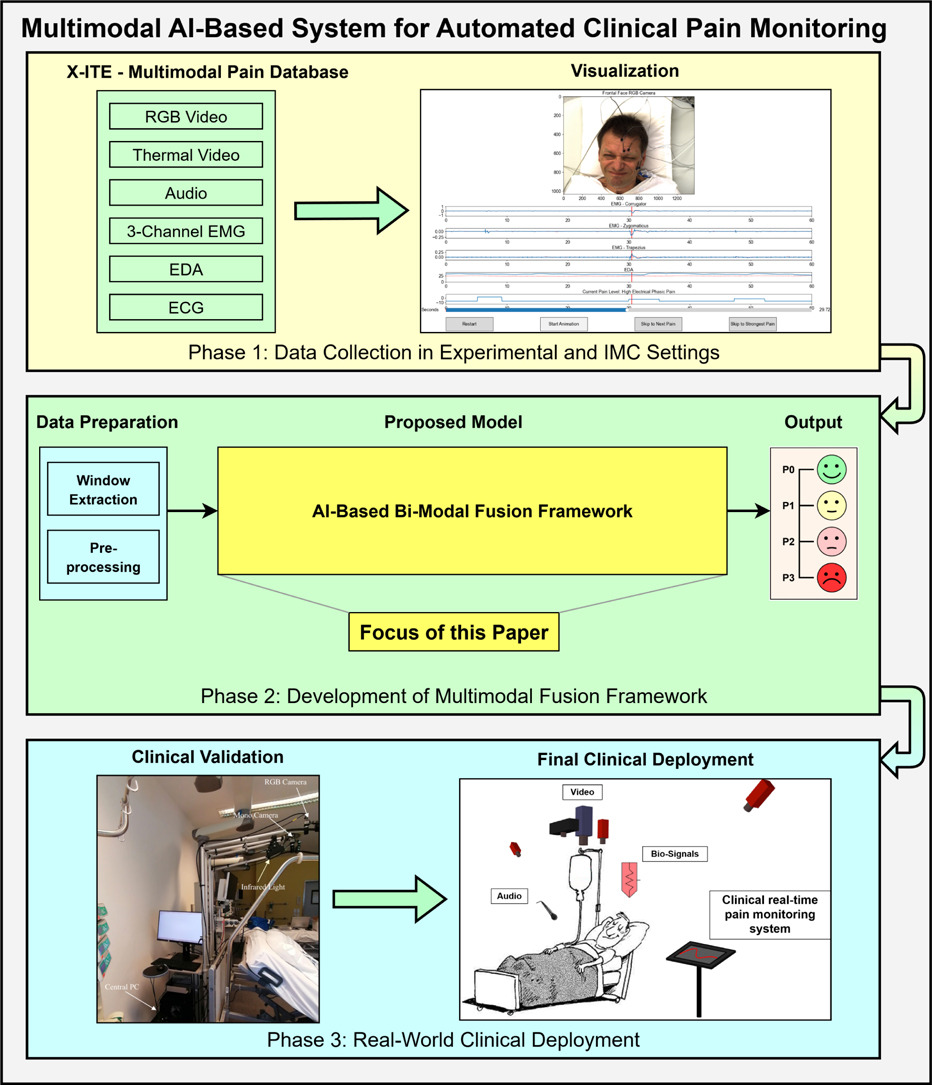
We present a privacy-preserving bi-modal framework for pain intensity classification that fuses EDA and EMG signals using an LSTM network with spatial attention and adaptive weighting, outperforming state-of-the-art methods with improved accuracy, robustness, and computational efficiency across multiple sub-datasets.
AI-based bi-modal fusion system for automated clinical pain monitoring
Pain is a highly subjective and multidimensional experience involving both physiological and psychological
factors. Developing accurate and robust pain monitoring systems is essential for effective assessment and
rehabilitation management. Recently, multimodal fusion combining physiological and behavioral signals has
gained attention for capturing complex pain responses. Unlike video and audio modalities that may raise
privacy concerns, physiological signals such as electrodermal activity (EDA) and electromyography (EMG) offer
a privacy-preserving alternative. In this study, we propose a bi-modal fusion framework based on EDA and EMG
signals for pain intensity classification. The framework integrates a Long Short-Term Memory (LSTM) network
with a spatial attention mechanism to capture both local and global temporal dependencies, and incorporates
an adaptive weighting module to enhance inter-modal feature interaction. To address the class imbalance
issue, we introduce focal loss as the loss function and apply a data-level jump reduction strategy. Extensive
experiments on 11 sub-datasets from the X-ITE pain database demonstrate that our method outperforms
state-of-the-art (SOTA) approaches, achieving an average accuracy improvement of 3.88% and a 7.12% gain
on the R-ETD sub-dataset. The model also exhibits more reliable performance on minority and challenging
classes, highlighting its robustness across modalities and sub-datasets. Moreover, the proposed method offers
improved computational efficiency and reduced resource consumption. These results suggest that the proposed
framework is a promising solution for multimodal pain monitoring with strong potential for real-world clinical
applications.
Fulltext Access
https://doi.org/10.1016/j.compbiomed.2025.111260
Citing
@inproceedings{WangBiModalPain2025,
    title = {AI-based bi-modal fusion system for automated clinical pain monitoring},
    author = {Wang, Huibin and Nienaber, Sören and Dinges, Laslo and Al-Hamadi, Ayoub},
    booktitle = {Computers in Biology and Medicine},
    year = {2025}
    }