GESTRO: Skeleton-Based Dynamic Gesture Recognition for Robot Teleoperation
GESTRO introduces a dataset of 11 dynamic gestures with 3,300 samples for intuitively controlling mobile autonomous systems, together with an LSTM model with attention achieving 98% accuracy, demonstrated on a mobile robotics platform.
GESTRO: Skeleton-Based Dynamic Gesture Recognition for Robot Teleoperation
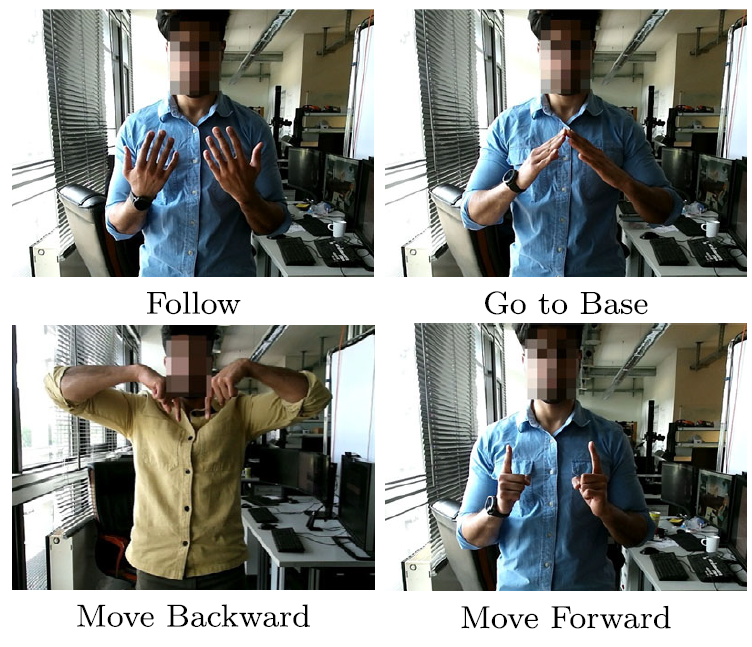
Improving HRI efficiency has gained significance in industrial settings where robots must understand gestures. This paper presents GESTRO, a dataset with 11 dynamic gestures (3,300 samples) for controlling autonomous robots. An LSTM model with attention achieves 98% accuracy. The evaluation examines data quality and the importance of dynamic sequences for accurate gesture detection, with the model implemented on a mobile robotics system to demonstrate usability in realistic human-robot interaction settings. The dataset and models are publicly available on GitHub.
Fulltext Access
https://doi.org/10.1007/s10846-026-02395-9
Citing
@article{hempel2026gestro,
  title={GESTRO: Skeleton-Based Dynamic Gesture Recognition for Robot Teleoperation},
  author={Hempel, Thorsten and Jung, Magnus and Khan, A. A. and Al-Hamadi, Ayoub},
  journal={Journal of Intelligent \& Robotic Systems},
  volume={112},
  number={2},
  pages={51},
  year={2026},
  publisher={Springer}
}