EDISON
Home
EDISON
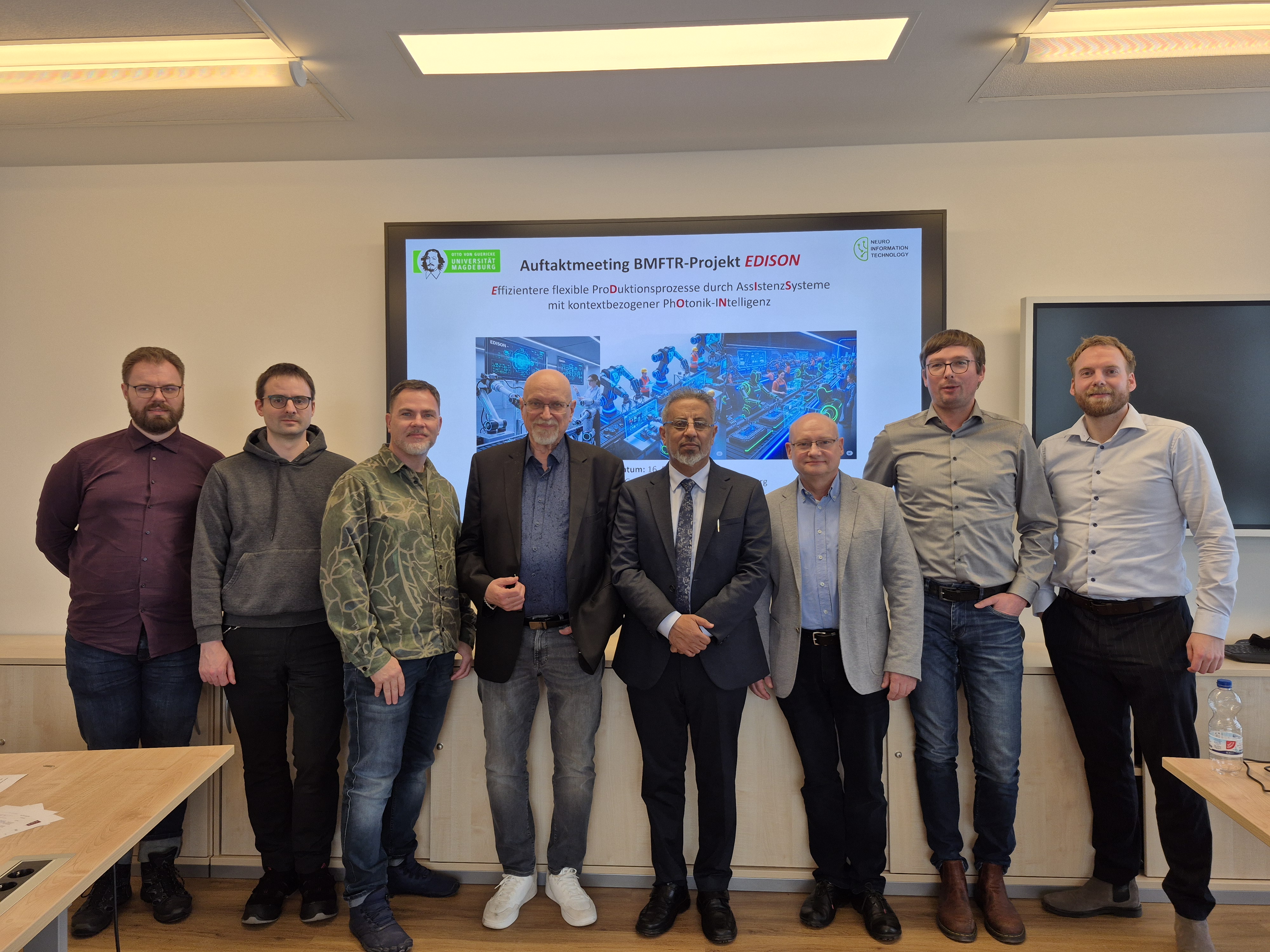
On January 1, 2026, the collaborative research project EDISON - More Efficient and Flexible Production Processes through Assistance Systems with Context-Based Photonic Intelligence - was officially launched. Funded with a total of €2.2 million by the Federal Ministry of Research, Technology and Space (BMFTR) under the program Photonics - Photonics for Digitized and Automated Production, EDISON aims to redefine the future of industrial manufacturing.
The project brings together a strong consortium of academic and industrial partners: MartinMechanic GmbH, LUCAS Instruments GmbH, HEMA Formenbau + Kunststoffverarbeitung GmbH, ZBS e.V., and Neuro-Information Technology at Otto-von-Guericke-Universität Magdeburg, supported by associated partner Pilz GmbH & Co. KG. Together, the partners combine long-standing expertise in intelligent photonic automation and human-centered production technologies.
Transforming Production with Photonic Intelligence and AI
EDISON’s mission is to fundamentally modernize manufacturing processes by integrating advanced photonic sensor technologies, artificial intelligence (AI), and adaptive robotic assistance systems. The project focuses particularly on small-batch production, enabling it to become more economical, flexible, and safe-meeting the growing demands for efficiency, customization, and innovation in modern industry 5.0.
At the heart of EDISON lies the seamless fusion of high-resolution optical 3D sensing, explainable AI, and intuitive human-robot interaction. Modern photonic sensors capture human actions and environmental conditions in real time. Intelligent algorithms interpret these contextual signals and translate them into precise robotic actions. This approach enhances existing production lines and enables rapid adaptation to new tasks and changing requirements.
Human-Centered, Adaptive, and Trustworthy
Aligned with the guiding principles of Industry 5.0-human centricity, resilience, and sustainability-EDISON develops context-sensitive assistance systems designed to work naturally and safely alongside human operators. Innovative methods such as one-shot learning and imitation learning allow robots to learn new tasks directly from human demonstrations, even with minimal training data. This creates the foundation for self-learning, adaptive production systems.
A key contribution of the Neuro-Information Technology group at Otto-von-Guericke-Universität Magdeburg is the development of a no-code robotics platform. This platform enables new workflows to be derived directly from human demonstrations and executed transparently. Photonic 3D scene data are combined with explainable AI models developed in compliance with the European Union’s AI regulatory framework, ensuring trustworthy and transparent human-robot collaboration.
From the outset, EDISON integrates certification, regulatory compliance, and functional safety into the development process, ensuring that research outcomes can be translated efficiently into real-world industrial applications.
Building the Next Generation of Cognitive Robotics
As part of the RoboSensation research cluster at Otto-von-Guericke-Universität Magdeburg, EDISON represents a significant step toward the next generation of cognitive robotics in industrial production-intelligent, flexible, safe, and explainable.
By combining cutting-edge photonic intelligence with adaptive robotics, EDISON contributes to strengthening sustainable and resilient automation “Made in Germany” and shaping the future of human-centered manufacturing.
News